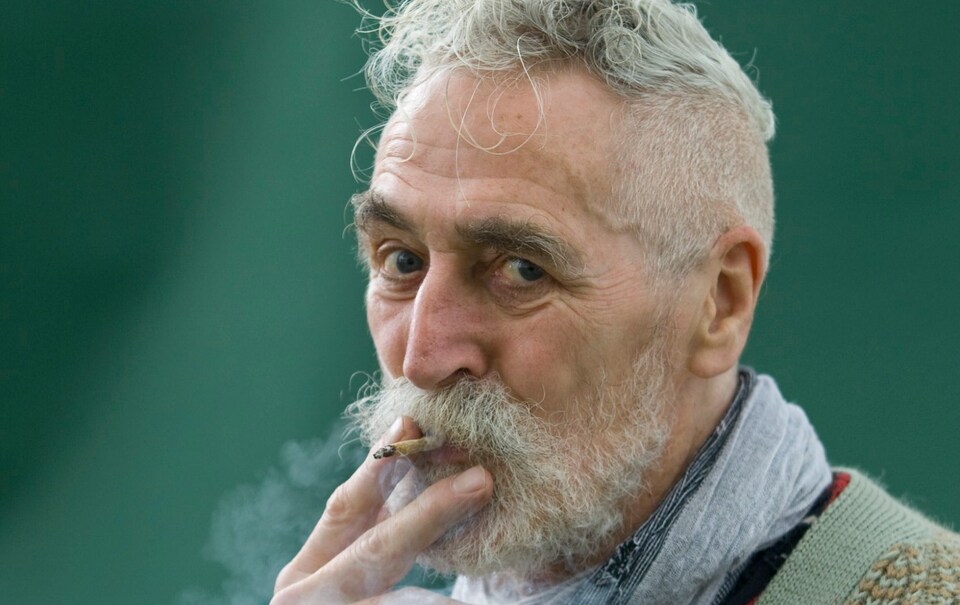
To be honest, I wasn’t familiar with the work of Scottish painter & playwright, John Byrne, until I read his obituary earlier this month. He died at the age 83 on 30 November 2023. There’s a brief video obituary on the BBC that gives a sense of his voice early and later in his career. The video clip gives a hint of his character and importantly, I think, something of his theory of art — its necessity in human experience and also the value of it being interwoven in everyday life. Although he reached high and was acknowledged for his achievement, there’s something fundamentally democratic about his approach to art. He reflects life as he experiences it and invites people into the work regardless of their familiarity with the arts. Everything I’ve read about him resonates deeply, and I’m sure I’m going to study his work a lot more deeply this winter.
Portraits and self-portraits were at the center of Byrne’s practice as Clare Henry writes in a lovely rememberence on Artlyst:
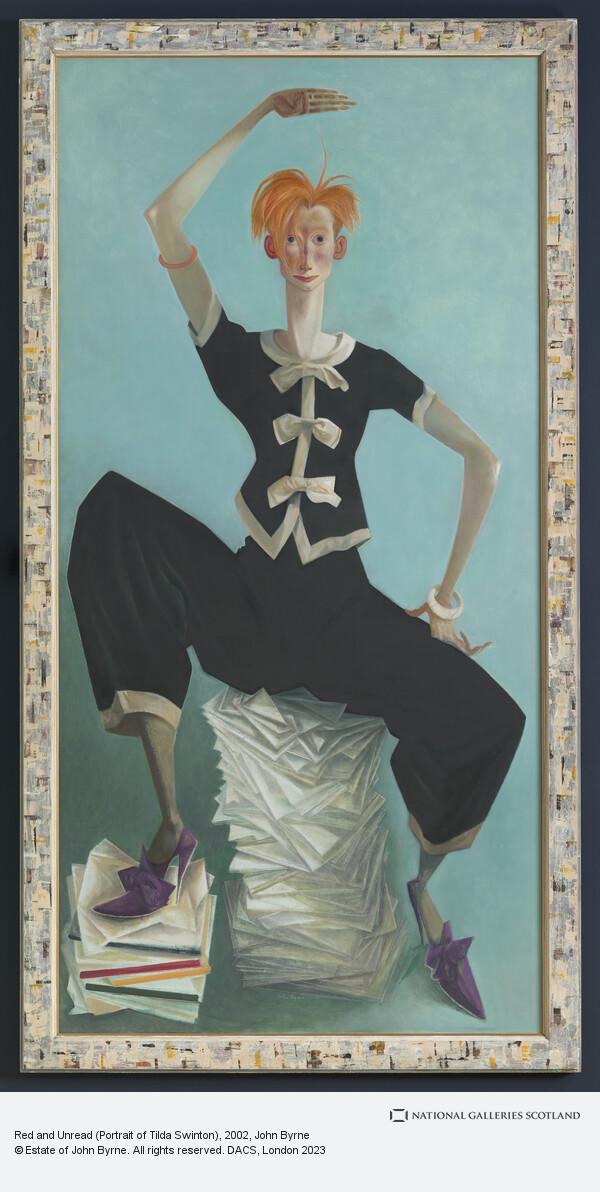
“People were his focus. ‘Landscapes don’t interest me that much. Abstraction doesn’t interest me at all.’ Byrne loved doing portraits, some verging on caricature. Even his life-size ‘formal’ picture of Tilda [Swinton, his former partner] is way over the top as she stands on a massive pile of discarded scrips. ‘The small pile by her right foot are the ones she’s done. I was out to capture her essence, something quintessentially her. More than a slavishly realistic image.’”
In the age of the selfie, any focus on self-portraiture is reflectively branded as part of a ‘narcissism epidemic.’ More thoughtful people will come to understand that narcissism results from the inability of people to see themselves in context. In this sense, Byrne’s work is the opposite of narcissism — a sensitive examination of the various dimensions of the self. Often verging on caricature, Byrne demonstrates a sly sense of humor and the willingness to present his foibles, quirkiness, and insecurity as clearly as any virtues he may share. Also from Clare Henry’s reflection:
“Byrne was fascinated by interior thought and outward appearance, his own included. Self-portraits abound. ‘A conversation with your psyche!’ An early one from 1972 in Flower Power’s hippy jacket is almost his only gentle version. For years, he used his face to explore aspects of design, fragmentation, decoration and colour in endless distinctive ways. ‘Why do you never quiz yourself? You have the means to do that: a forensic examination of your psyche and outward face to the world. People seem to skip over that quite lightly; I can imagine why it doesn’t intrigue everybody!’”
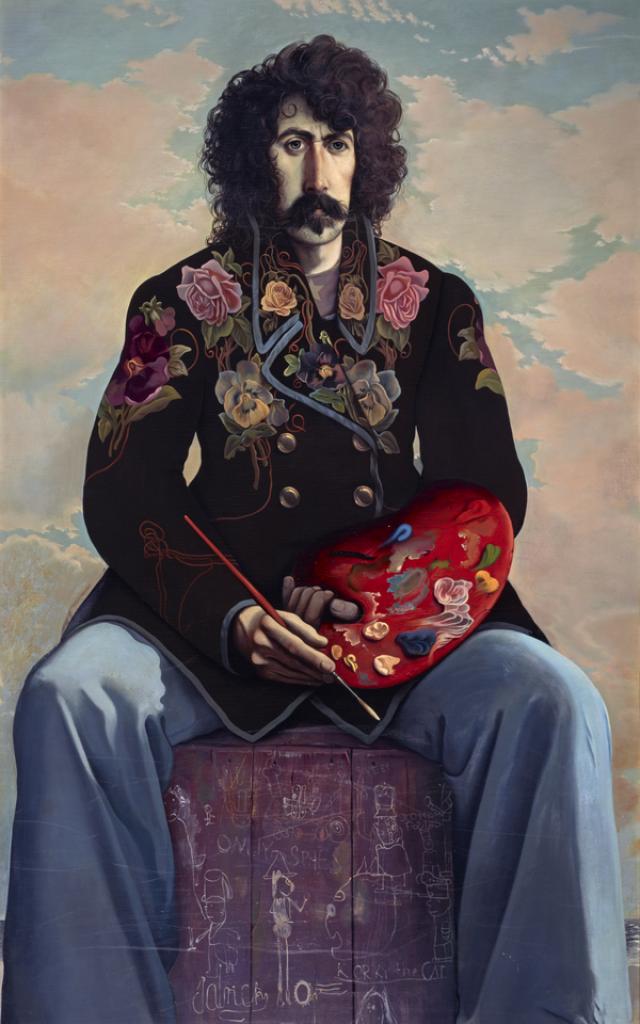
John Byrne, (Self-portrait in a Flowered Jacket) 1971 – 1973
A ‘democratic’ dimension of his work can be found in his many album covers. He had a love of music and, being at the center of cultural life in the UK for a generation, he knew many of the people for whom he created album artworks. One iconic album cover was for The Beatles. They approached him to design the cover of for the White Album, but ultimately went a different direction, however the artwork resurfaced as the cover of their 1980 compilation, The Beatles Ballads.
I won’t begin to write about his playwriting or screen writing because I haven’t started to study this. But it’s clear he was iconic.
There’s some fine writing about the specifics of John Byrne’s artworks, and I’m particularly taken with Georgiana Coburn’s reflection on his 2014 exhibition at the National Galleries of Scotland, Sitting Ducks. Glasgow Life also has a good overview of his 2022 retrospective at Kelvingrove Art Gallery and Museum.
The National Galleries of Scotland released this video in support of his show:
I also love this conversation between Byrne and the actor, Peter Capaldi:
Another longform video is this terrific conversation between Byrne and Frank Quitely:
This documentary offers a snapshot of the life of artist and writer John Byrne as he completes a large mural for the dome of the King’s Theatre in Edinburgh (in two parts):
 pete hocking
Hi Pete,
Happy holidays. I hope this finds you well.
Thank you for sending me the introduction on
John Byrne. I started researching him with the
links you provided and found it very interesting.
I am also eager to dive into the index of resources
you sent. I truly appreciate your knowledge and
generosity.
Sending my love to Ptown. I miss it soâ¦
2024 will mark my return in some way.. hopefully
with art makingâ¦
I hope the New Year will bring you some sweet surprises,
fulfillment and moments of joy.
All my best,
[cid:DF21090A-5713-49D0-97C5-822B615A9384]
Derek
D Derek (he/him)
Artist
http://www.dderek.comhttp://www.dderek.com
derek@dderek.comderek@dderek.com
@dderekman