The Venus cycle from 2002 to 2026 spans a major 24-year cycle in astrology and astronomy, where Venus repeats its synodic rhythm with Earth every 8 years and traces a 5-pointed geometric star in the zodiac. The recurring autumn retrograde signature in Scorpio and Libra (2002, 2010, 2018, and 2026) ties together long-term themes of relationship evaluation, financial reassessment, shadow healing, and releasing past weight. The October 2026 Venus Star Point marks the culmination of long-running patterns, closing out historical cycles that echo back through 2018, 2010, 2002, and earlier. These are some reflections on my 24-year Venus cycle (previously posted to Instagram and FaceBook).
…
1. In October 2002 I was on sabbatical from my job as director of the Swearer Center for Public Service at Brown University, and writing a thesis for my first graduate degree (MFA in Interdisciplinary Arts). It was a pivotal time for me, as I was starting to turn from a career focused on social action toward a career as an artist (which is where I’d started 18 years before).
I’m at another pivotal point, and I’m trying to take stock of where I’ve come from, and the foundation I’ve built. I’m also considering how my past can inform my direction but not determine it. In the introduction to her seminal book, Releasing the Imagination, Maxine Greene evokes Charles Taylor when she writes, “It has been said that if we as individuals are to determine what our relationship is to some idea of the good, ‘we must inescapably understand our lives in narrative form, as a quest.’” And there I am.
At 36 I had energy to burn (and, boy-o-boy, did I!). I could tilt at windmills and dart from one preoccupation to another. At 60 I need to be more discerning. And I also want my “stages on life’s way” — Greene’s evocation of Kierkegaard — to add up to something bigger, more meaningful. However, it’s not like you can articulate a quest and just get to work. It emerges from the making. And on this October day, as was probably true on that October day, I’m impatient with the emergent. I want clarity. I know I won’t get it.
In my New Year’s resolutions for 2026, I set a goal related to this: Go underground for a bit & imagine and articulate your vision & aspirations. It’s probably time to be accountable to this goal and sort my obligations from my aspirations, the old me from the possible me.
…
2. When I was in art school I recognized that I wasn’t very good at solitary studio practice. I was eager to be in the world, building relationships, and having an impact. After graduation I chose a path that would allow that, and while I didn’t exactly abandon my life as a painter I definitely let it go fallow. By my mid-30s I was back in the studio, totally lost, and at the receiving end of misaligned advice from my graduate program. It basically took me another decade to find my footing as a painter.
I was also wrestling the anxiety that arose from trying to be all things to all people. At times the anxiety was derailing, and too often I self-medicated. But there were moments in the studio, after internally processing the quarrels that dogged me, when I was able to enter a nearly perfect flow state and lose myself in the work. Those moments signified breadcrumbs toward a better tomorrow.
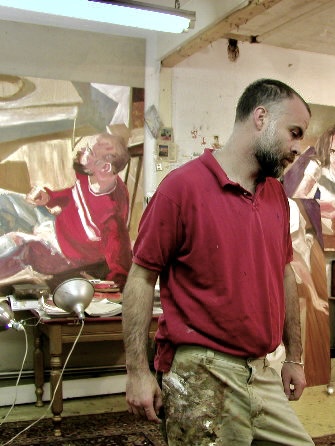
Writing my thesis over the fall semester of 2002 provided a respite. On sabbatical, I was free of the pressures of professional performance. And writing a thesis was an inarguable excuse for almost anything thrown at me. It wasn’t a perfect time, and I struggled with a sense of disconnection (hence the self-portrait on the left) and loneliness. I know I had high hopes for major breakthroughs at the time, but I’m not sure I experienced any. I’m not sure I was open to them.
I’m better at solitary studio practice today (and managing my anxiety), in large part because I’m better at being accountable to myself before worrying about the expectations of others. That allows me to be with myself for long periods of time. Lucian Freud talked about his ‘selfishness’ in building firewalls around his studio life, and always putting his work before relationships. Now that I’m better at being alone, I sometimes wish I were better at protecting my time. But I’m still called toward relationship and a broader engagement with the world. Which means more consideration of what I want to balance, what I’m willing to balance, and what I’m ready to let fall.
…
3. Graduating from art school a professor, who encouraged me to become a professional painter, said off-handedly, ‘don’t worry about what you’re making now, you won’t make a significant painting until after you’re 30.’ It pissed me off.
I’ve wrestled with my education’s quality, both art school & graduate school. When I name my art school, I’m reflexively told I was lucky to get in. But my experience was uneven, with little support outside the classroom & a few dodgy experiences in the classroom. Graduate school, and maybe this is the nature of graduate school, was intensely ideological, with particular ways of making art (& ways of knowing) valorized at the expense of other ways of making art (& ways of knowing).
Becoming a painter has been largely an experiential eduction — alone in the studio, building a relationship with materials, & unearthing what you have to say. This isn’t to say I didn’t benefit from demonstrations of technique, conversations about the nature of painting, research into the work of other artists, or critical response. In fact, the more I teach the more often I return to some of the (brilliant) lessons of my art school professors, particularly Bill Drew, Jean Blackburn, Brice Hobbs & Tom Sgouros. Those lessons were never about orthodoxy, but rather always about finding one’s way.
I’m not sure I’ve made a ‘significant painting’ — or that I know what that means. I do know that I’ve made good paintings, had crises of faith, moments of confidence, & periods when I’ve questioned the whole enterprise. I’ve never valued an individual painting more than my archive. I’m enough of a writer to see each painting as a chapter in something larger.
My reflections aren’t a crisis of faith or a questioning of the enterprise. Rather they’re about aspiration & meaning. The photos are from a moment I was writing a thesis, which required me to take a position and represent my knowledge. I’m unsure how much of it I would defend today. (I can tell you one thing, I’m not re-reading it!). Whatever it contains is integrated in me. Today I’m not interested in defending what I know and more interested in starting the next volume.

