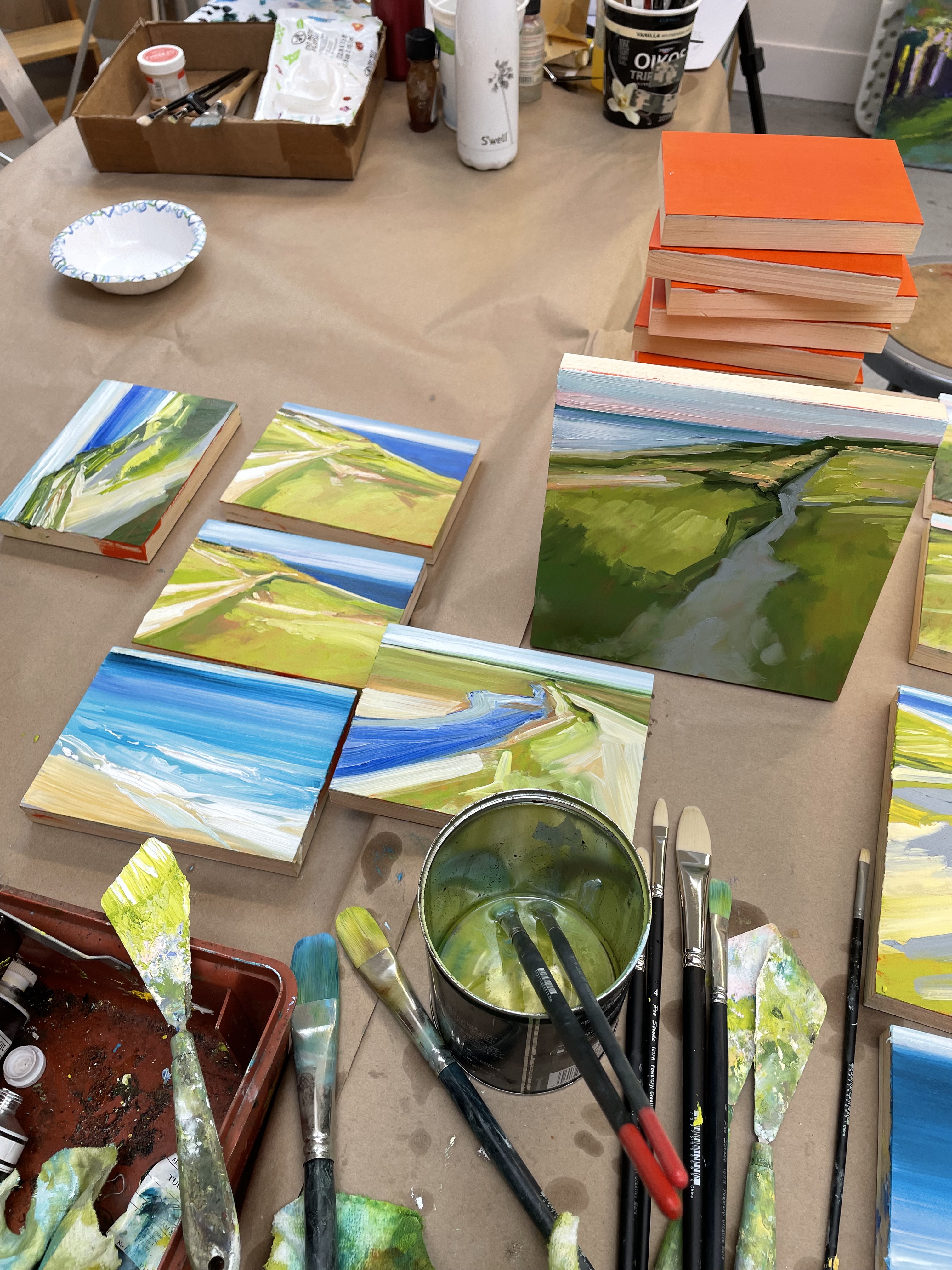
I led a workshop at Provincetown Arts Association and Museum last week. It wasn’t my first -‘in person’ workshop since the pandemic, but teaching in a studio still feels like a novelty. I’m always grateful for the generosity and drive brought into a workshop by participants — and this workshop felt particularly rich given the level of collegiality in the room.
This week I recognized three of my teaching tropes, and I thought it might be useful to articulate them.
Practice v Technique
I start every workshop by saying in some way or another ‘If you’re here to learn to paint like me, you‘re in the wrong place. My job is to help you paint more like you.’ I know some folks need some basic technique demonstrations and I’m happy to provide them. But I try to moderate my technique demonstrations to reflect multiple ways of painting — not my way of painting. My language of painting comes through my body. And that language was developed through practice.
Practice is a set of actions one takes regularly in pursuit of a goal. For me, this includes painting as many days a week as I can, looking at great paintings by others as often as possible, engaging in visual research daily, and paying attention to how people engage with my work. Painting is a conversation across time. I have to look and listen to what’s come before me, what’s happening around me, what contributions I’m making to advance the conversation, and how others are responding to my contributions. It’s like any healthy relationship.
There is no easy answer to ‘how do I learn to paint?’ There are no steps to follow to find your voice as a painter. It’s about taking risks, not being afraid to wipe things out and try again, and to look for the things that work all along the way. If you’re conscious about what you’re doing, you’ll develop a ‘tool box’ of skills and strategies.
Language of Color v Color Mixing
A lot of people arrive in workshops having taken a color mixing class or believing they don’t understand color. There are basics of color theory that are useful to every painter. But too often people get stuck on the intricacies of color mixing and ‘developing a palette’ and never actually paint.
I respect every approach to working with color. But I worry that the ‘science’ of color mixing can become an impediment to ‘learning by doing.’ I believe we learn more about color on the canvas than on the palette.
My colors are generally hyper-saturated because I’m interested in the memory of place rather than the verisimilitude of place. That means I lean on the hyper-saturated feeling of color in my memory. A sunny day at high noon is always more intense in memory than the washed out reality of a bleached, shadowless landscape. I’ve developed a language of color and that trusts my body’s experience of place.
The Integration of Painting and Drawing
Historically drawing has often been subordinate to painting. Traditionally students spent years in the drawing room before being allowed to touch paint. This makes sense economically — when paint was incredibly expensive. But it does’t necessarily make sense for every artist. I learned to draw using paint. Fluid media make much more sense to me than traditional drawing media — because they allow me to create volume and space in a more embodied way. I think in passages of color and value, not via line.
I love drawings that use traditional drawing media. I believe very strongly that drawing should be embraced and respected as a medium. And I also love when paint is used as a drawing medium. Approaching painting as drawing allows the view to see the process. And pushing the boundaries between the traditions helps us to make some really exciting contemporary work.
I’m teaching a workshop on this topic this summer at Truro Center for the Arts, so I’m sure I’ll have more to say soon.

