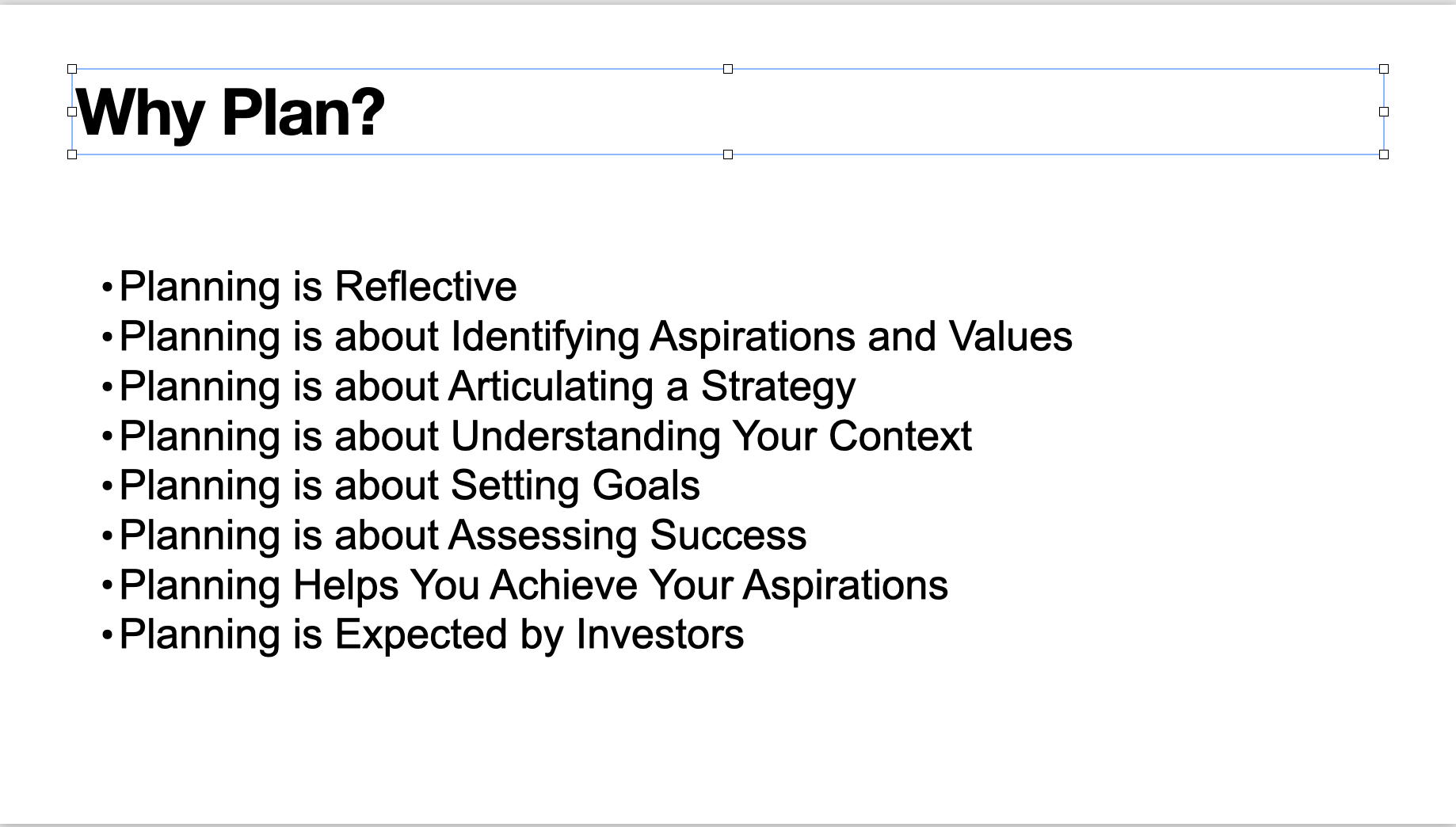
The images in this post are slides from my presentation at Provincetown Commons on Tuesday, 20 February 2024. Sorry they’re a little wonky — they looked great on the screen!
This week, I gave a workshop on planning at Provincetown Commons. It’s part of a professional development series we’re offering with the Outer Cape Community Development Partnership. While it was ostensibly a ‘business planning’ workshop, I extended the metaphor to be inclusive of studio, learning and life planning. My rationale for extending the metaphor has to do with the vocational complexity of being an artist. Unlike other jobs I’ve had, I never leave the office. My art practice is an integrated part of my life. And to plan effectively, I need a holistic approach. In my experience this is true of other artists who, unlike me, might not think of themselves as a ‘small business owner,’ and who might better thrive through a different facet of their identity.
Why should artist’s make business plans — or plans that extend that metaphor? In my experience, business planning is often about showing donors, investors or. lenders that there’s a solid foundation for your enterprise. While this might be the case for some artists — who are opening studios, galleries, or other ventures that need capital — it’s not really the case for artists like me, who make things and sell them in a pretty direct manner. No client or colleague has ever asked me for a business plan — or a plan of any kind. Nevertheless, I’m a committed planner. Foremost, I think the ethos of planning is an integrated facet of my studio practice. It’s reflective, focused on uncovering my aspirations, and keeps me attentive to my context, goals, and whether I’m being successful in pursuing what I value. It’s not so much an external expectation laid onto my practice, but rather something my practice emerges from.
When I taught at Goddard College, part of my job was to help students develop something we called a ‘study plan.’ As a school that grew through 20th century theories of Progressive Education, our curriculum was student-centered — starting with a set of ‘degree criteria’ that provided a vessel for the questions and goals students brought to their studies. This allowed us to work with artists from a vast range of life experience without being pedantic. I found the process to be really useful, so much so that I would develop my own study plan every semester alongside my students. Since leaving higher education, I now develop a ‘learning and work plan’ every quarter — reviewed and revised at least monthly and overhauled at each equinox and solstice.
For years I also helped small and start-up non-profits develop organizational development plans. While people often experience this kind of planning to be imposed on them, and a distraction for their work, I’ve found the process of planning to always be reflective, clarifying, and to offer an opportunity to articulate and affirm one’s core values. Also, I know from my own work that seeking resources is geometrically easier if one has done thoughtful planning. Proposals and grants snap together with ease when you’ve articulated your vision and goals and can easily refer to a document.
Unlike most businesses, art making isn’t production or providing a service. It’s a way of ‘thinking through materials.’ My theory for approaching planning this way is to uncover and articulate the thinking that’s already going on in one’s art practice and to articulate it into something that’s useful in advancing the aspirations of one’s practice. It’s more about the development of the artist than the development of the art. I believe that artists who are attentive to their own growth and development will make artwork that enacts and embodies their growth.
There’s a lot more I can say about this topic — and no doubt did in the workshop on Tuesday night. However, I think this planning process is something to be sparked and not defined. In that spirit, below are some of the slides I created for the presentation. It’s not the whole presentation, but rather keep examples from my own practice. Where necessary, I’ve offered some annotation in the captions.
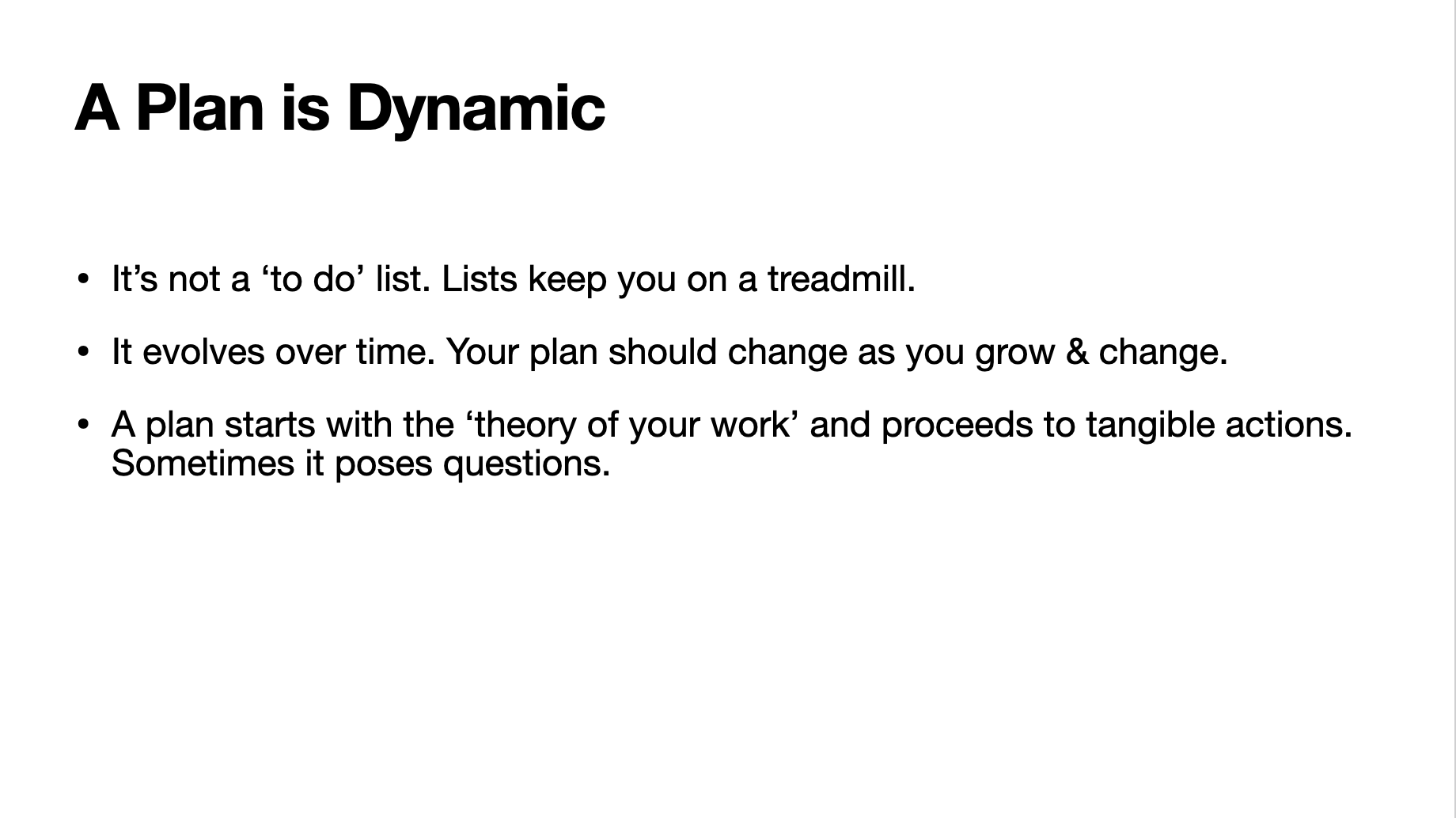
Planning is not a list of things to do.
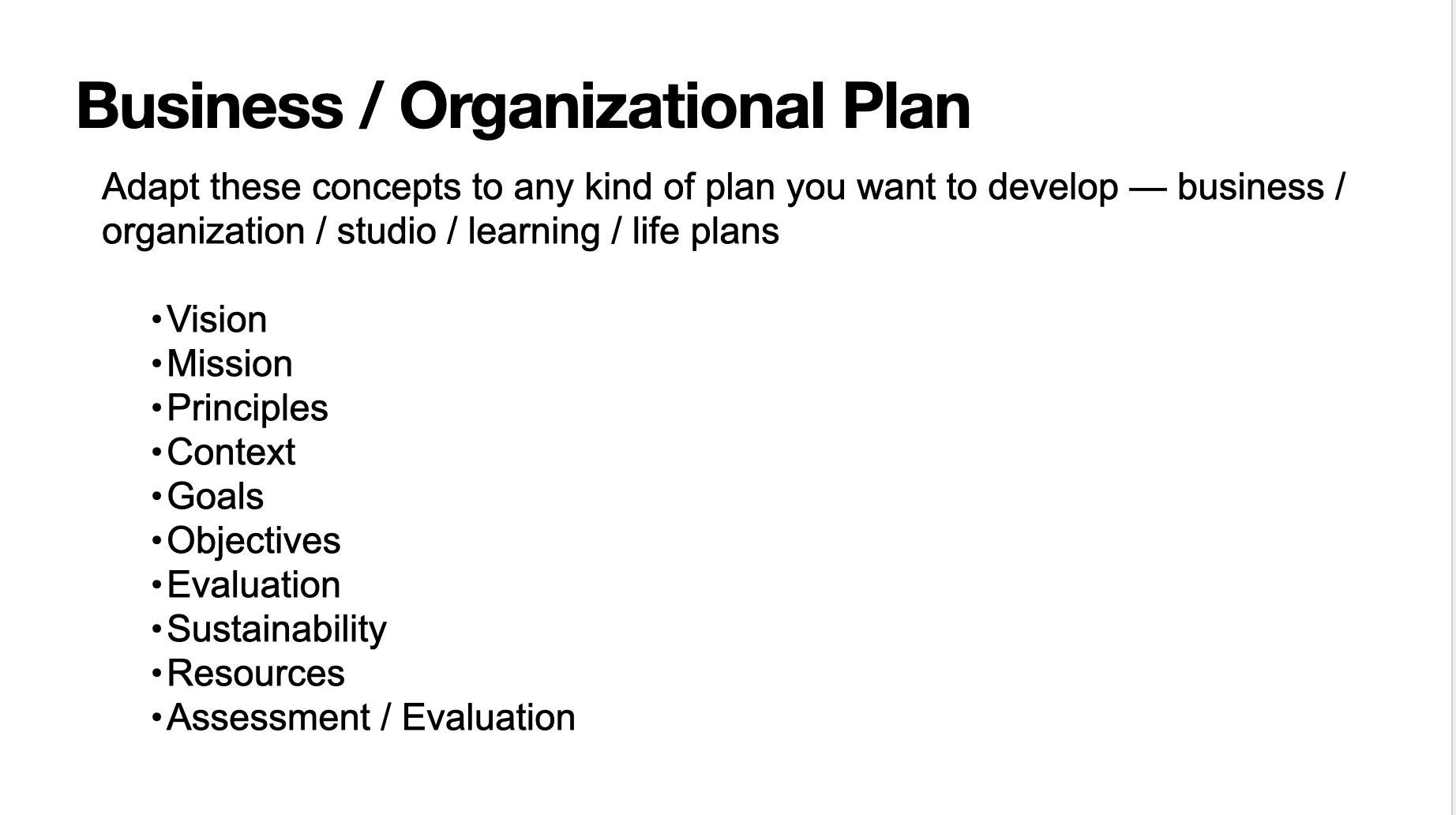
A classic matrix for organizational or business planning. This is what I would use if I were coaching a non-profit in development or helping someone start a small business.
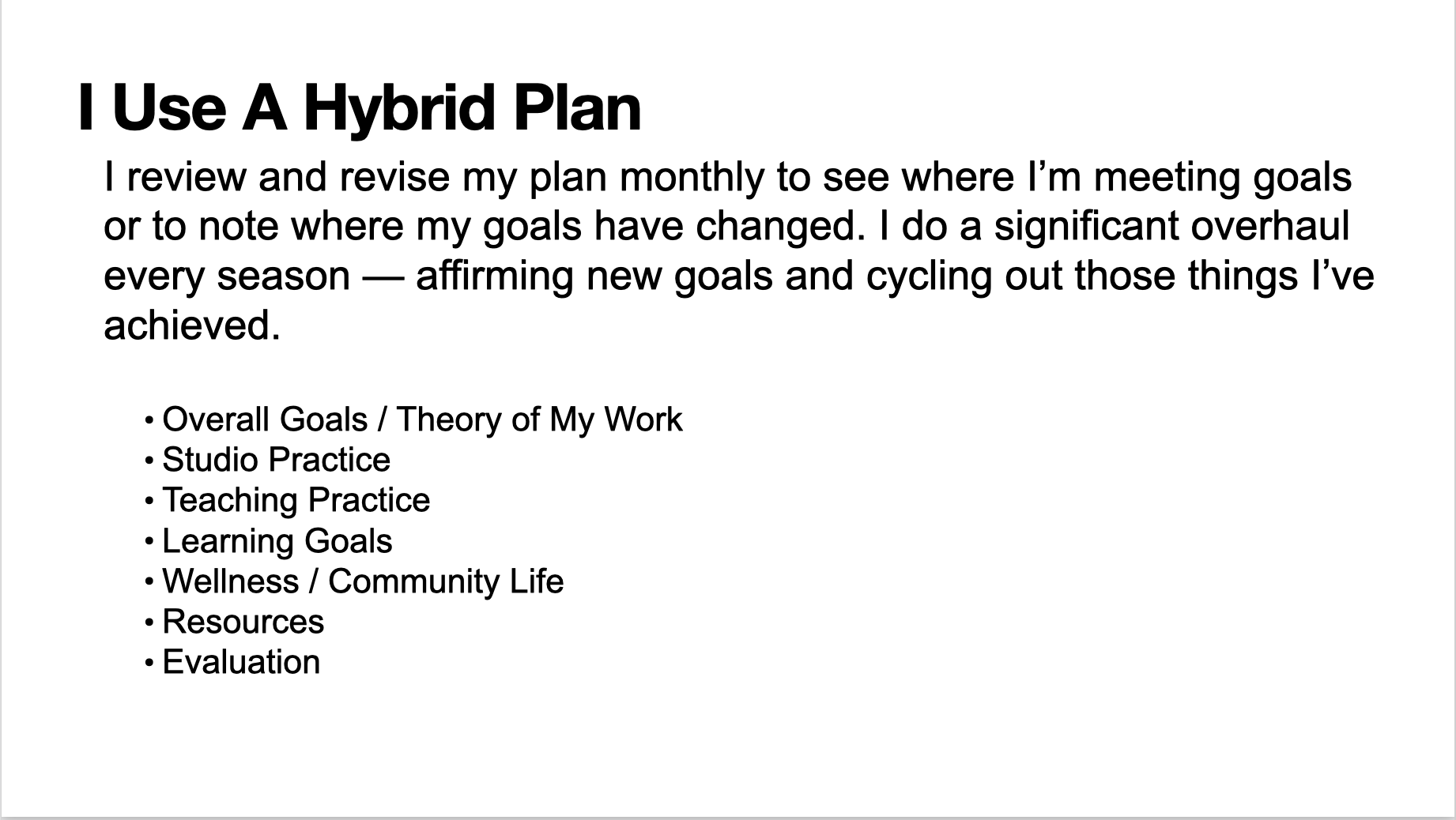
I use a hybrid process — shaping it from things I’ve learned from curriculum development and business planning. It’s a balance that works for me. Below is the basic outline I use for each bulleted point.
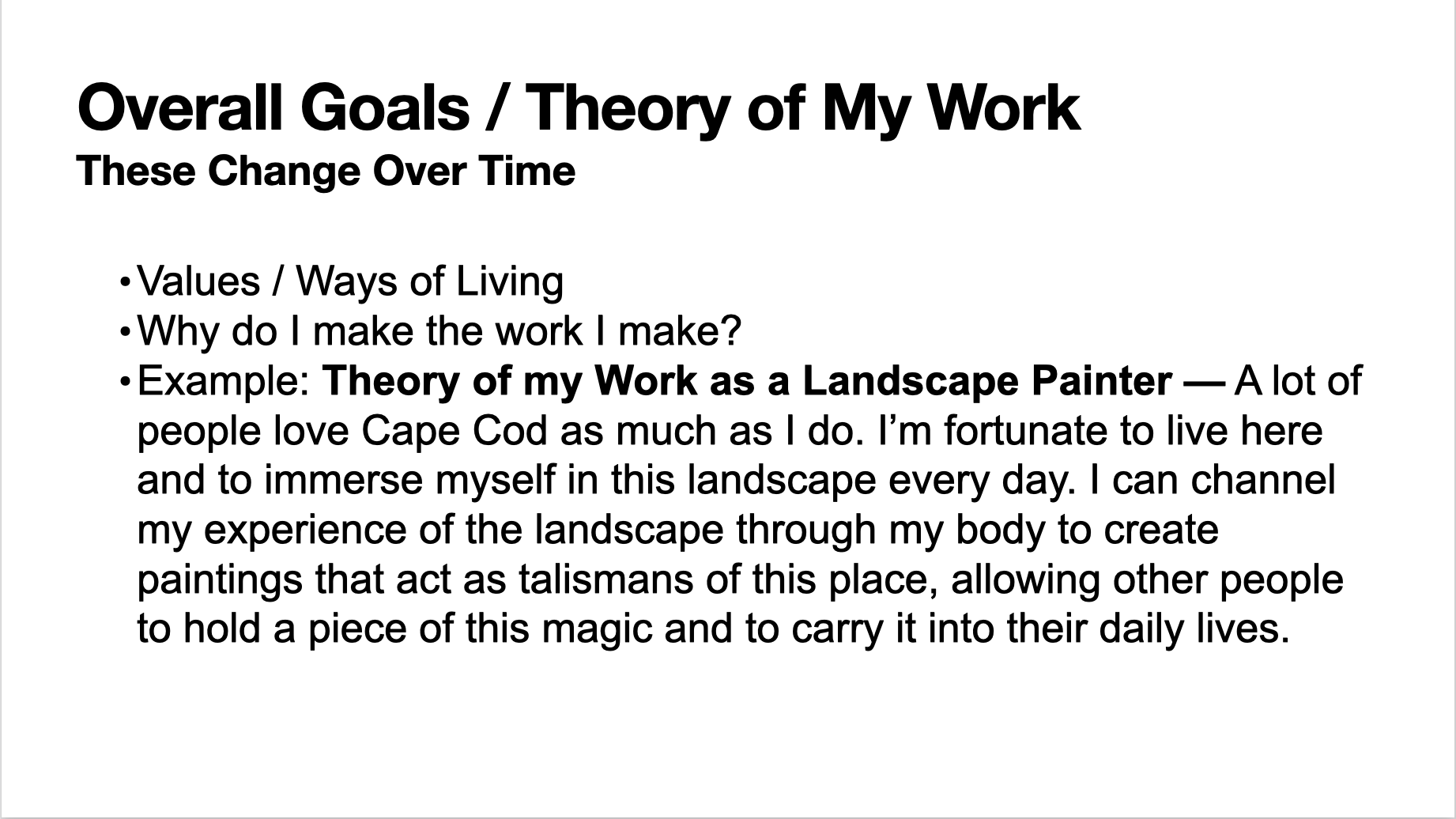
The theory of my work comes from my values and reflection on my relationship to a shared community.
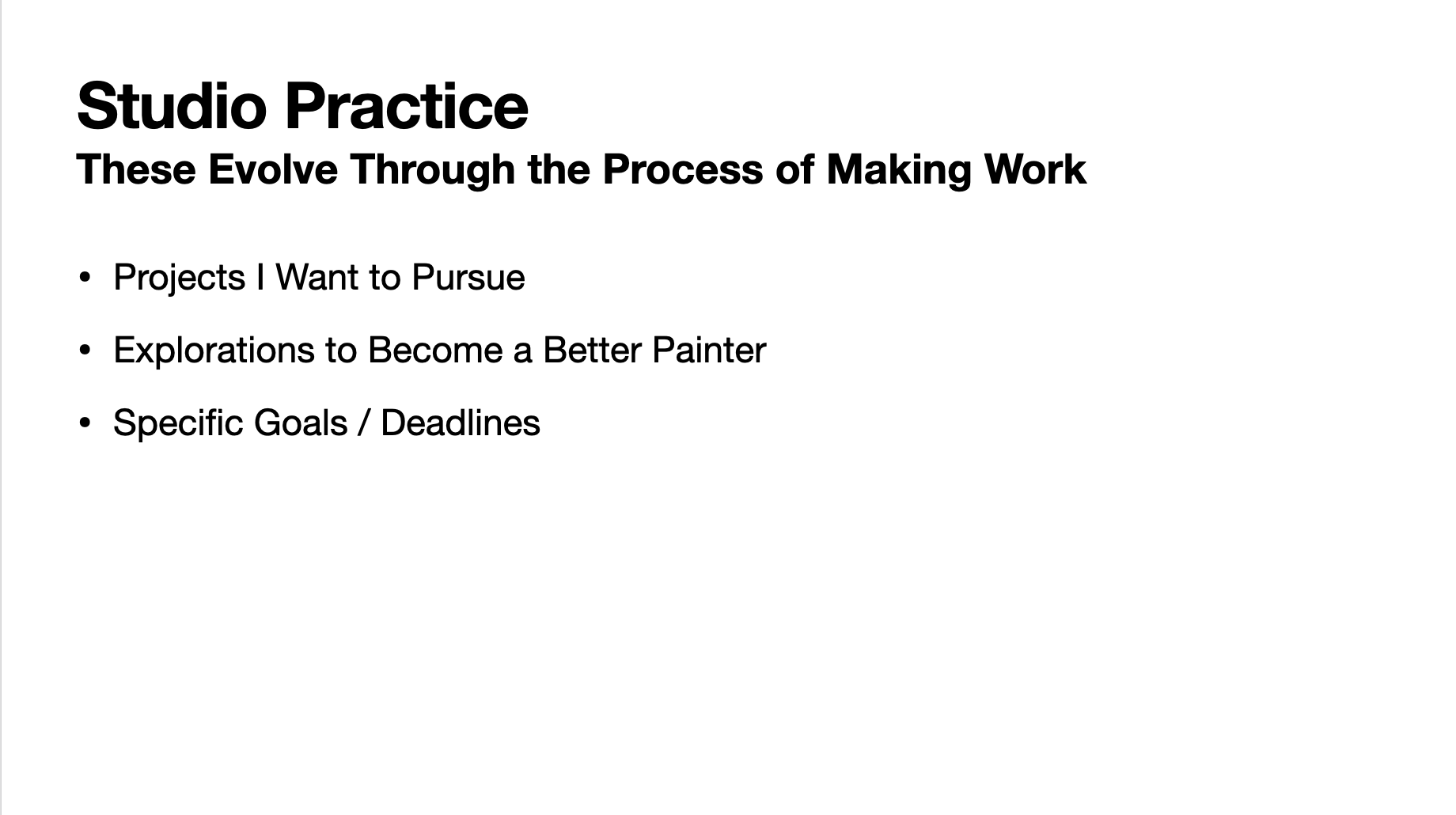
This section, on Studio Practice, captures ideas I have for projects, aspirations for improving as a painter, and concrete learning goals. It also establishes deadlines for projects, shows, and commissions.
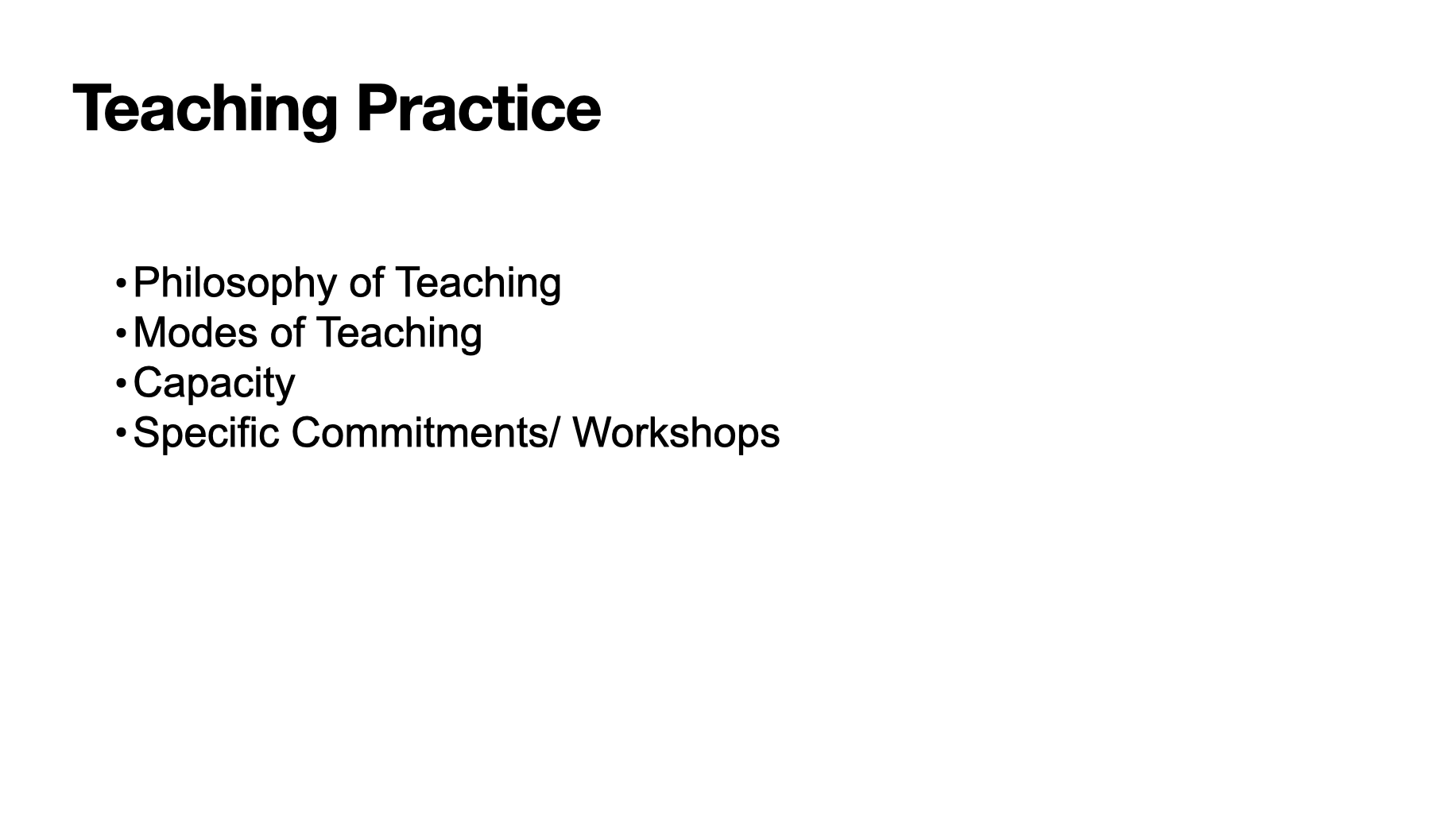
Teaching is an integral part of my practice and identity. It takes a lot of creative energy and can subsume all my time if I don’t plan carefully. This section helps me balance opportunities with my capacity while also documenting specific commitments.
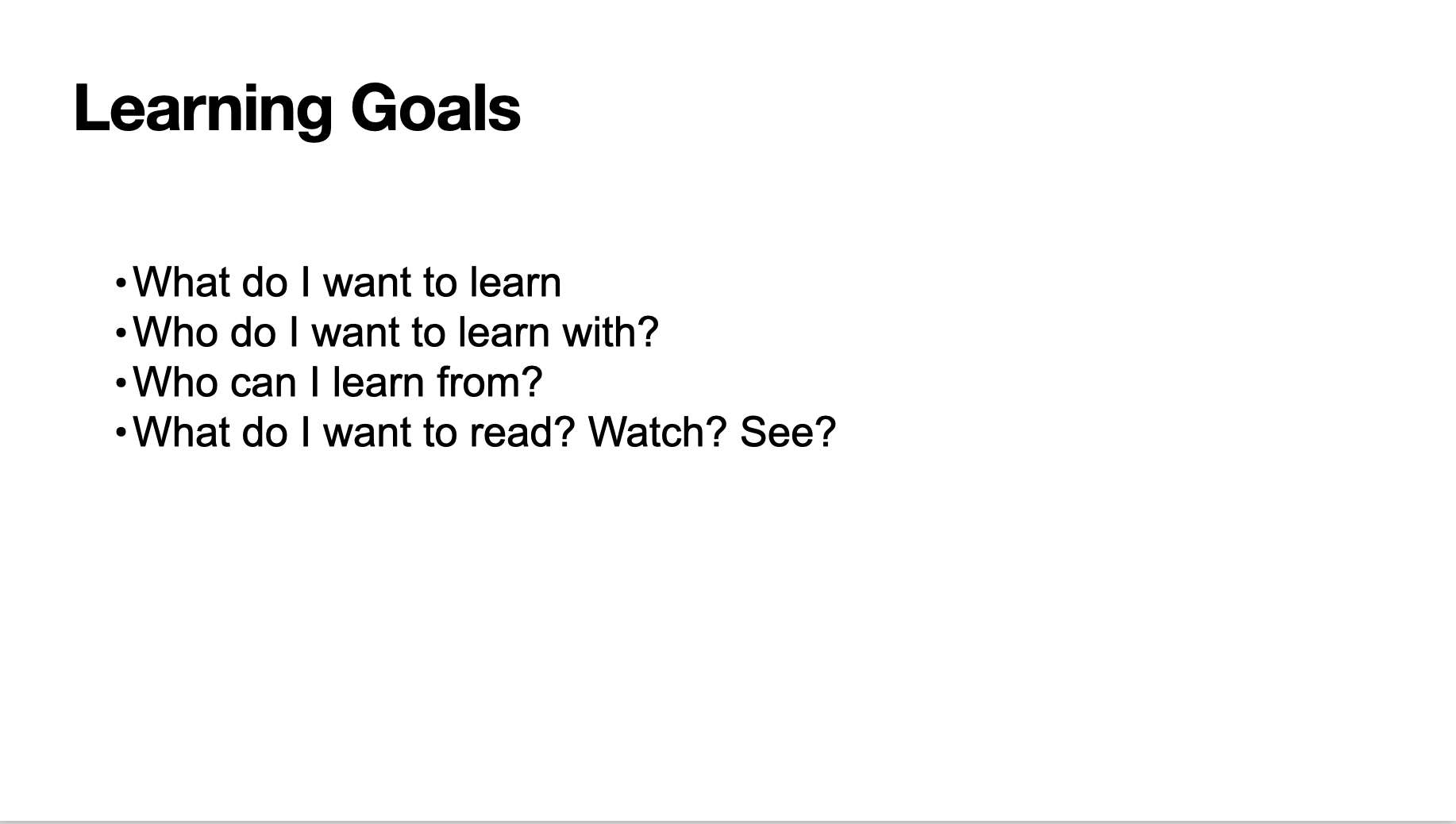
Learning Goals are super important to me. If I’m not learning and growing, my work as an artist will remain stagnant. I don’t want to make work that looks like work I made a decade ago. I want my growth to be evident in the work that emerges every year.
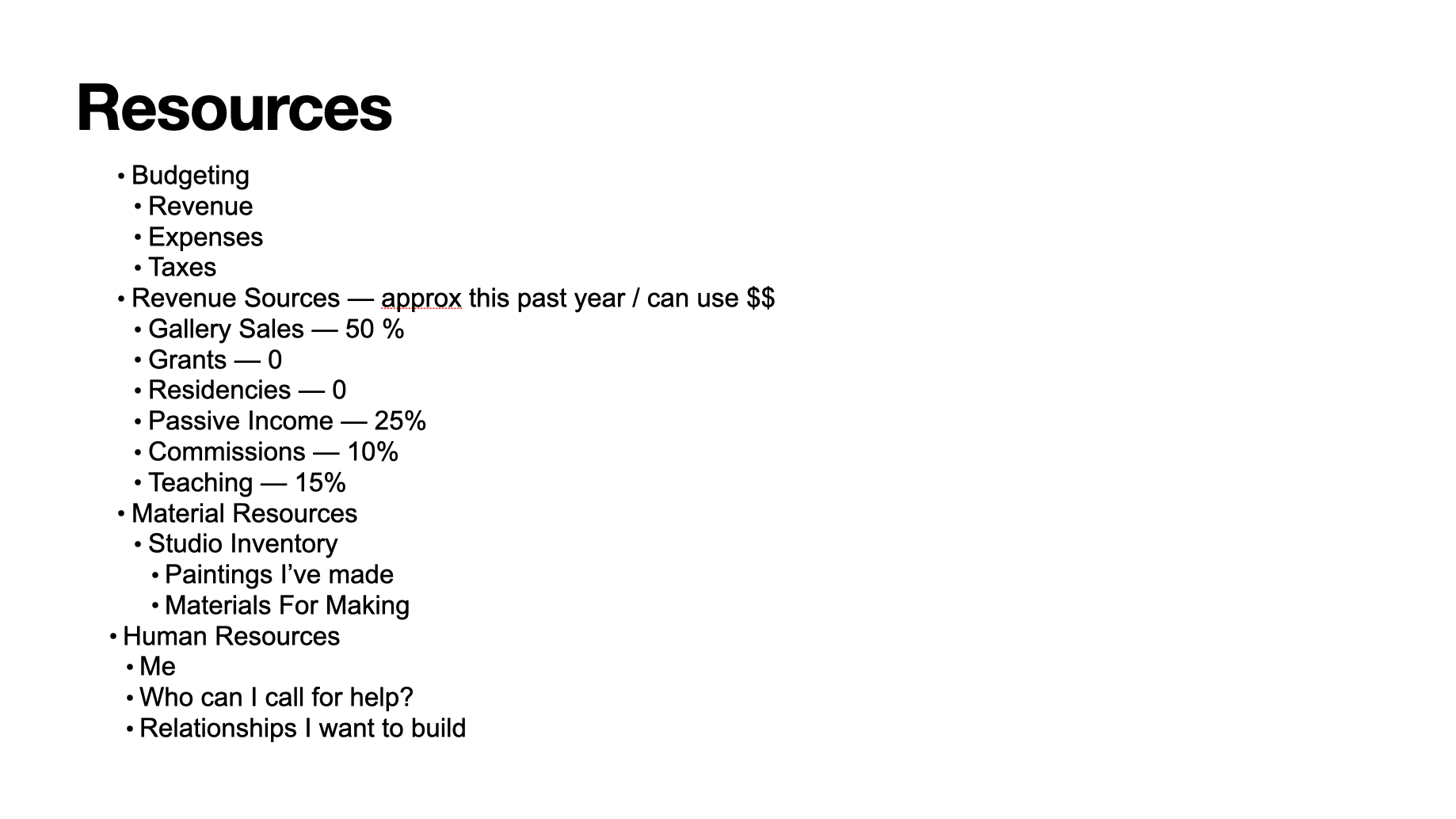
Resources are something I think about a lot. I need income to maintain the basics of my life. Art materials are expensive. I also have to think about my assets beyond what’s in my bank account. And my most important resources are people — who are willing to help me with physical tasks, but more importantly who are willing to help me learn and grow.
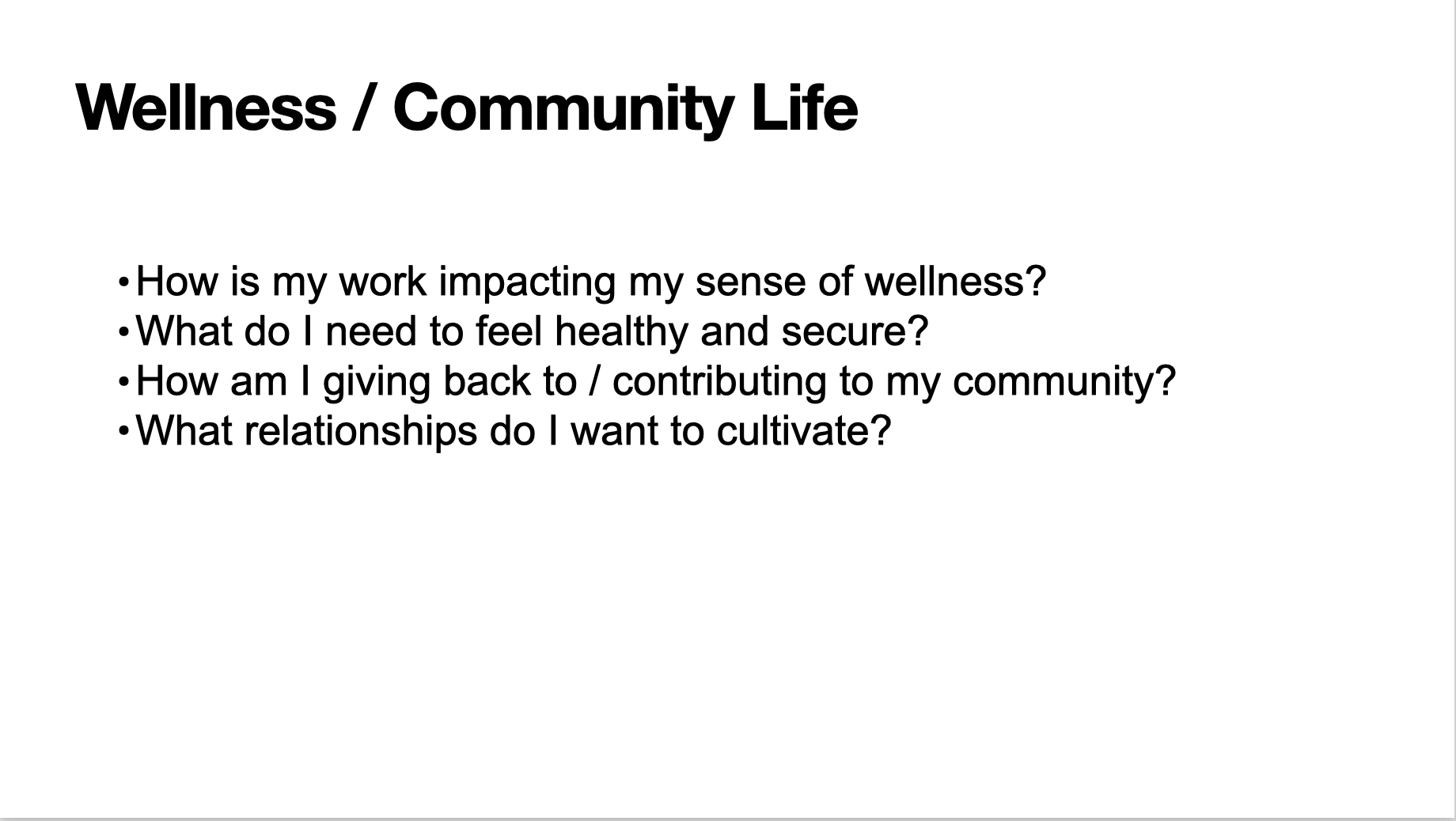
Wellness is the cornerstone of everything. If I’m not physically and emotionally on top of my game, the work simply won’t happen. For me, engagement with and contributions to my community are a central part of my capacity to engage in my solitary studio practice.
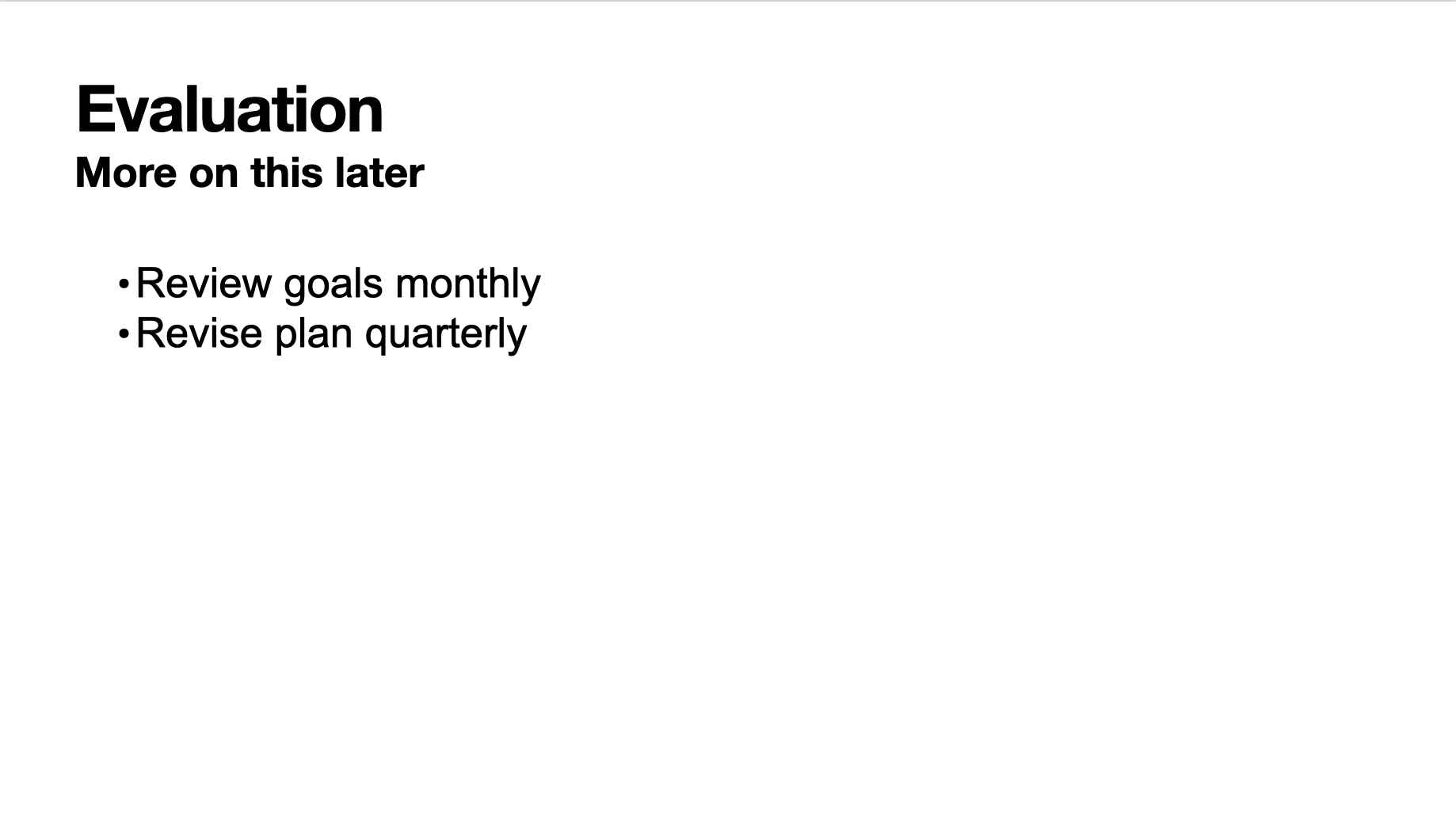
Evaluation lets you know whether you’re succeeding.
 pete hocking
Bravo Pete, lots and lots of food for thought. Thank you.
Thoroughly enjoyed your presentation. Lots of great information and ideas for moving forward with my art “life” as a business. Thank you!
I’m signed up for all the other presentations as well —- very generous to have the opportunity – and for no cost!
Thanks, Joy! So glad you could join us. Glad it was useful!!
This is a very helpful and comprehensive way to think about my process, goals and aspirations. Thank you so much for sharing Pete.
<
div>💜
Sent from my iPhone
<
div dir=”ltr”>
<
blockquote type=”cite”>